Mental Age vs Chronological Age: What the Gap Really Means
You have two ages that can tell very different stories. One is fixed by your birth certificate. The other describes how you perform, think or feel compared with people of different ages.
This guide explains mental age vs chronological age in plain terms, shows how psychologists once combined them into an IQ score, and helps you read an online mental age result without over-reading it.
Quick Answer: Mental Age vs Chronological Age
Chronological age is the time you have been alive, counted from your date of birth. Mental age is the age group whose typical test performance matches yours. A 10-year-old who solves problems like an average 12-year-old has a chronological age of 10 and a mental age of 12.
The gap between the two was the basis of the early “ratio IQ” formula. Today, psychologists compare adults with people their own age instead, and online mental age quizzes are for fun, not diagnosis. If you are curious about your own result, you can take the free mental age test and then use this guide to interpret it.
What Is Chronological Age?
Chronological age is your age measured in time since birth. Merriam-Webster defines it as “the age of a person as measured from birth to a given date.”
It is the only one of your “ages” that everyone born on the same day shares exactly. That is why tests, schools, doctors and researchers use it as the fixed reference point that every other kind of age is compared against.
- How it is counted: years, months and days from your birth date to today.
- What it ignores: health, ability, mood, experience and maturity.
- Why it matters here: mental age only makes sense when it is set against chronological age.
What Is Mental Age?
Mental age is a score that says which age group your performance matches. It was designed for children, whose abilities grow quickly and predictably from year to year.
The idea comes from French psychologist Alfred Binet, who built a scale with Théodore Simon in 1905 to identify schoolchildren who needed extra help. Test items were grouped by the age at which an average child could pass them. Binet himself called the result a “mental level”; the phrase “mental age” was popularized by his American translators, according to Riot IQ.

Binet treated mental age as a useful snapshot, not a fixed trait. He believed it could change with teaching and experience. For a fuller look at how the concept developed, see our guide to mental age in psychology.
Mental Age vs Chronological Age Compared
The two ages answer different questions. Chronological age asks “how long?” while mental age asks “performing like whom?”
| Feature | Chronological age | Mental age |
|---|---|---|
| What it measures | Time since birth | Test performance matched to an age group |
| How you get it | From your birth date | From a standardized test with age norms |
| Can it change? | Rises by exactly one year every year | Can rise faster, slower or level off |
| Same for everyone born the same day? | Yes | No |
| Most useful for | Everyone, as a reference point | Children, historically |
| Used in modern IQ scores? | Yes, to choose the comparison group | Rarely; replaced by deviation scores |
In short, chronological age is the ruler and mental age is the reading. A mental age above chronological age signals above-average performance for that age, and a mental age below it signals below-average performance.
How the Two Ages Were Combined Into a Ratio IQ
The original IQ was simply mental age divided by chronological age. German psychologist William Stern proposed this quotient in 1912, and Lewis Terman of Stanford University multiplied it by 100 in his 1916 Stanford-Binet test so that average would equal 100.
The Ratio IQ Formula
Ratio IQ = (mental age ÷ chronological age) × 100
When the two ages are equal, the score is exactly 100. A higher mental age pushes the score above 100, and a lower one pulls it below.
Worked Examples
| Chronological age | Mental age | Calculation | Ratio IQ |
|---|---|---|---|
| 10 | 12 | (12 ÷ 10) × 100 | 120 |
| 10 | 10 | (10 ÷ 10) × 100 | 100 |
| 8 | 6 | (6 ÷ 8) × 100 | 75 |
| 40 | 16 | (16 ÷ 40) × 100 | 40 |
The first three rows behave as expected. The last row shows the problem covered in the next section. You can practise more examples in our step-by-step guide on how to calculate mental age.
Why the Comparison Breaks Down for Adults
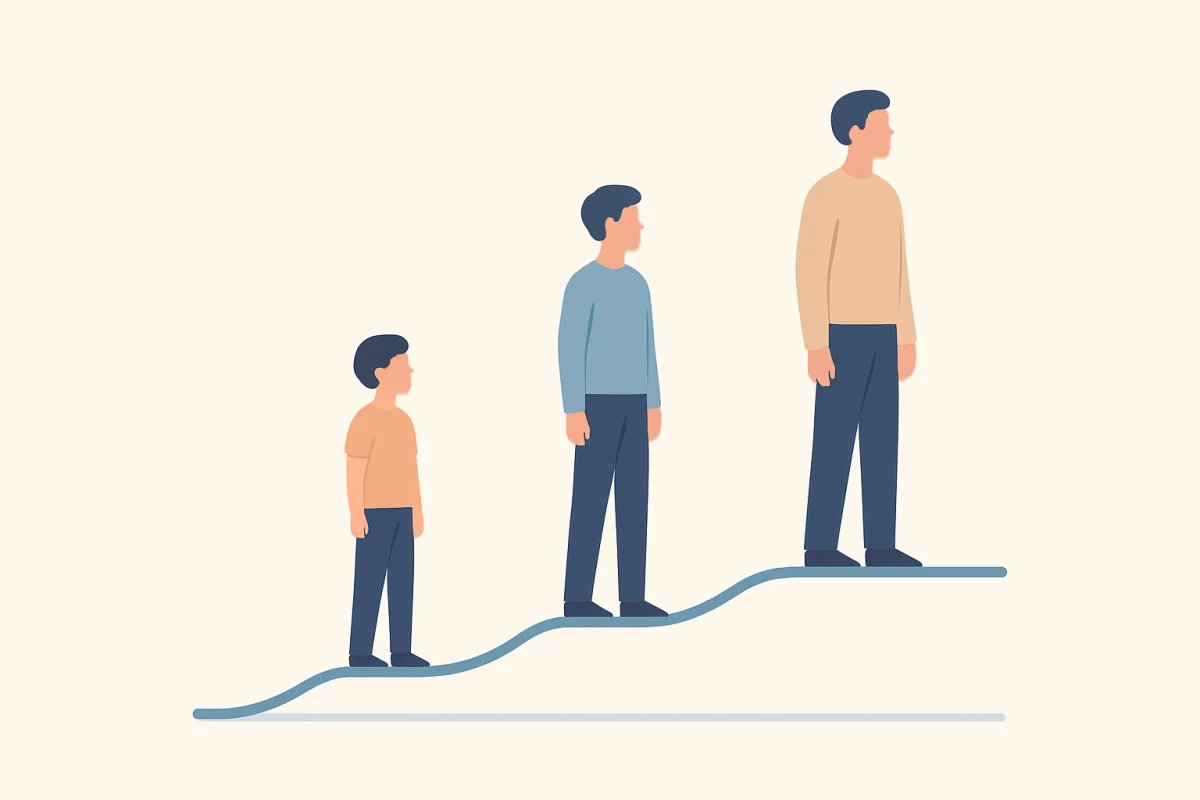
Mental age stops being meaningful in adulthood because measured mental ability levels off in the mid to late teens while chronological age keeps rising. Terman himself noted that intelligence “improves but little after the age of 15 or 16 years.”
That creates the absurd result in the table above. A perfectly typical 40-year-old whose test performance matches an adult level of about 16 would get a ratio IQ of 40, which no one would accept as accurate. As Mensa International explains, the ratio works for children but not for adults, because mental development stops increasing with age.
What Replaced It: the Deviation IQ
Modern tests compare you with people of your own chronological age instead of converting your score into a mental age. David Wechsler’s 1939 scale introduced this “deviation IQ,” which is set so the average for each age group is 100 with a standard deviation of 15.
So chronological age still matters, but in a different way. It now decides which group you are compared with, rather than being the bottom half of a fraction. A score of 115 means you scored about one standard deviation above the average for your age group.
Other Ages People Confuse With Mental Age
Many online pages use “mental age” for three other ideas. Keeping them separate prevents most of the confusion around this topic.
| Type of age | What it describes | How it is estimated |
|---|---|---|
| Chronological age | Time since birth | Birth date |
| Mental (cognitive) age | Test performance matched to an age group | Standardized, normed tests |
| Biological age | How your body is aging | Medical and lab markers |
| Subjective age | How old you feel | Asking people directly |
| Emotional maturity | How you handle feelings and relationships | Observation and self-report |
Biological Age
Biological age refers to how your body is aging compared with others of your chronological age. It is not the same as chronological age, even though at least one quiz site uses the two terms as if they were identical.
Subjective Age
Subjective age is the age you feel, and most older adults feel younger than they are. In a University College London study of 6,489 people published in JAMA Internal Medicine in 2014, the average chronological age was 65.8 while the average self-perceived age was 56.8.

- 69.6% felt at least three years younger than their real age.
- 25.6% felt close to their real age.
- 4.8% felt more than a year older.
Over an average follow-up of about eight years, 14.3% of those who felt younger died, compared with 24.6% of those who felt older. The researchers stressed this is an association, not proof that feeling young causes longer life, and that health behaviours and outlook may explain part of the link.
Emotional Maturity
Emotional maturity is about self-control, empathy and judgment. A child can be intellectually advanced and emotionally young at the same time, so a single “mental age” number cannot capture both.
What Your Online Mental Age Result Actually Tells You
An online mental age quiz reflects your answers about habits, tastes and attitudes, not a clinical measurement. Psych Central, for example, labels its own quiz “for entertainment purposes only” and states it is not an empirically validated test.
If Your Result Is Higher Than Your Real Age
Your answers lean toward preferences and habits the quiz associates with older people, such as caution, routine or a calm social life. It does not mean your brain is aging faster.
If Your Result Is Lower Than Your Real Age
Your answers lean toward curiosity, playfulness or openness to new things. It does not mean you are immature or less intelligent.
Use this quick checklist before you take any result seriously:
- Check whether the quiz says how it was built or tested. Most do not publish norms or reliability data.
- Notice whether the questions are about ability (puzzles, memory) or preferences (music, weekends). Preference quizzes measure personality style, not mental age.
- Retake it on a different day. Big swings show the score is not stable.
- Treat the number as a conversation starter, not a label.
- If you have real concerns about memory or thinking, talk to a doctor or psychologist rather than relying on a quiz.
Limits and Criticism of the Mental Age Idea
Psychologists moved away from mental age because it hides important details. Psychometrician L. L. Thurstone called the concept “a failure” back in 1926, citing its ambiguities.
- Unequal steps: psychologist Jerome Sattler pointed out that a one-year gap does not mean the same thing at every level. The difference between mental ages 2 and 5 is far larger than between 12 and 15.
- Different profiles, same number: two people with the same mental age may have passed very different items.
- Labelling concerns: some disability advocates and researchers describe phrases like “the mental age of a child” as reductive or infantilizing for adults.
- Modern practice: clinicians now judge intellectual disability mainly by adaptive functioning, meaning everyday living skills, alongside standardized scores.
None of this makes the comparison useless. It simply means mental age works best as a historical teaching tool and a rough way to describe a child’s progress, not as a verdict on an adult.
The Bottom Line
Chronological age is fixed by the calendar; mental age describes performance against age norms and was built for children. The ratio between them created the first IQ scores, but it fails for adults, which is why modern tests compare you with your own age group instead.
If you want to keep your thinking sharp at any age, our guides on how to increase memory power and how to remember everything you read are good next steps. And if you are simply curious how your answers compare, try the mental age test and read your result with the checklist above in mind.
Frequently Asked Questions
What is chronological age?
Chronological age is the amount of time you have been alive, measured from your date of birth to a given date. It rises by exactly one year every year and is the same for everyone born on the same day.
Is it good if my mental age is higher than my chronological age?
In a child’s standardized test, a mental age above chronological age means above-average performance for that age. In an online adult quiz, it usually just means your answers lean toward habits the quiz links with older people, not that your brain is aging faster.
How do you calculate IQ from mental age and chronological age?
The historical ratio IQ formula is mental age divided by chronological age, multiplied by 100. A 10-year-old with a mental age of 12 scores (12 ÷ 10) × 100 = 120. Modern tests use deviation IQ instead.
Why is mental age not used for adults?
Measured mental ability levels off in the mid to late teens while chronological age keeps rising, so the ratio gives absurd results. A typical 40-year-old with an adult mental level of about 16 would score 40. Adults are now compared with people their own age.
Can your mental age change?
Yes. Alfred Binet saw mental age as a snapshot that could change with teaching and experience, and online quiz results can shift from day to day. Chronological age is the only age that never changes pace.
Are online mental age tests accurate?
Online mental age quizzes are for entertainment. Most publish no norms or reliability data, and sites such as Psych Central state their quiz is not an empirically validated test. See a professional if you have real concerns about memory or thinking.