Mental Age Calculator: How to Turn an IQ Score Into a Mental Age
A mental age calculator turns an IQ score and a real age into a “mental age”, the age at which an average person would perform at the same level. The math takes ten seconds. Reading the result correctly takes a little more care, especially if you are over 16.
This guide gives you the formula, a worked example in months, a lookup table you can read at a glance, and a plain explanation of when the number means something and when it does not.
Quick Answer
Mental age = (IQ × chronological age) ÷ 100. A 10-year-old with an IQ of 120 has a mental age of 12, because 120 × 10 ÷ 100 = 12.
The formula only gives a meaningful result for children and young teens. Reasoning ability levels off in the mid-teens, so for adults the result is arithmetic, not a measurement. If you want a fun estimate of how old you think and act, take our mental age test instead.
How a Mental Age Calculator Works
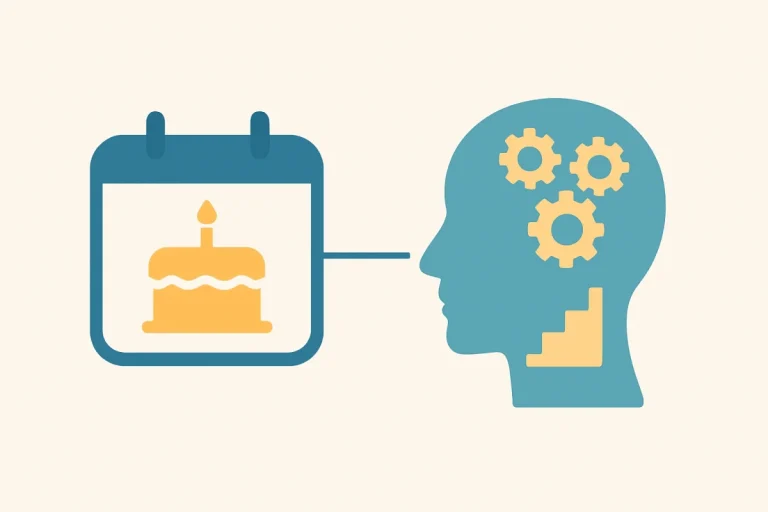
A mental age calculator uses the ratio IQ formula, which compares the age level a person performs at (mental age) with their actual age (chronological age). It needs two of the three numbers and solves for the third.
The idea goes back to the Binet-Simon scale of 1905, which grouped test tasks by the age at which typical children could pass them. A child who passed the tasks an average 8-year-old passes had a mental age of 8.
The three versions of the formula
The same ratio can be rearranged to find any missing value. Use the version that matches what you already know.
| You want to find | Formula | Example | Result |
|---|---|---|---|
| Mental age (MA) | (IQ × CA) ÷ 100 | IQ 120, age 10 | 12 years |
| Ratio IQ | (MA ÷ CA) × 100 | MA 12, age 10 | 120 |
| Chronological age (CA) | MA ÷ (IQ ÷ 100) | MA 12, IQ 120 | 10 years |
An IQ of exactly 100 always gives a mental age equal to real age. An IQ above 100 gives a mental age above real age, and an IQ below 100 gives one below it.
Why months give a sharper answer
Working in months avoids rounding errors for young children, where a few months make a real difference. Convert the age to months, apply the formula, then convert back.
Example: a child aged 8 years 6 months is 102 months old. With an IQ of 120, the mental age is 102 × 120 ÷ 100 = 122.4 months, which is about 10 years 2 months.
How to Calculate Mental Age by Hand in 4 Steps
You can do this on any phone calculator. Here is the full process, using the months method for accuracy.
- Write down the IQ score. Use a score from a properly administered test if you have one.
- Convert the real age to months. Multiply the years by 12 and add the extra months.
- Multiply the months by the IQ, then divide by 100. This gives the mental age in months.
- Convert back to years. Divide by 12. The whole number is years, and the remainder is months.
For more worked examples and the reverse calculation, see our step-by-step guide on how to calculate mental age.
Mental Age Lookup Table by IQ and Age
This table shows the ratio formula applied to common IQ scores at ages 6 to 16. Values are in years; 0.1 of a year is about 1.2 months.
| IQ | Age 6 | Age 8 | Age 10 | Age 12 | Age 14 | Age 16 |
|---|---|---|---|---|---|---|
| 70 | 4.2 | 5.6 | 7.0 | 8.4 | 9.8 | 11.2 |
| 85 | 5.1 | 6.8 | 8.5 | 10.2 | 11.9 | 13.6 |
| 100 | 6.0 | 8.0 | 10.0 | 12.0 | 14.0 | 16.0 |
| 115 | 6.9 | 9.2 | 11.5 | 13.8 | 16.1 | 18.4 |
| 130 | 7.8 | 10.4 | 13.0 | 15.6 | 18.2 | 20.8 |
Treat the figures in the top-right corner with caution. A “mental age” of 18 or 20 is not a level that early test designers could measure, because typical performance stops rising around the mid-teens. For a closer look at one score, read what mental age an IQ of 70 means for children and adults.
Why the Calculator Gives Strange Results for Adults
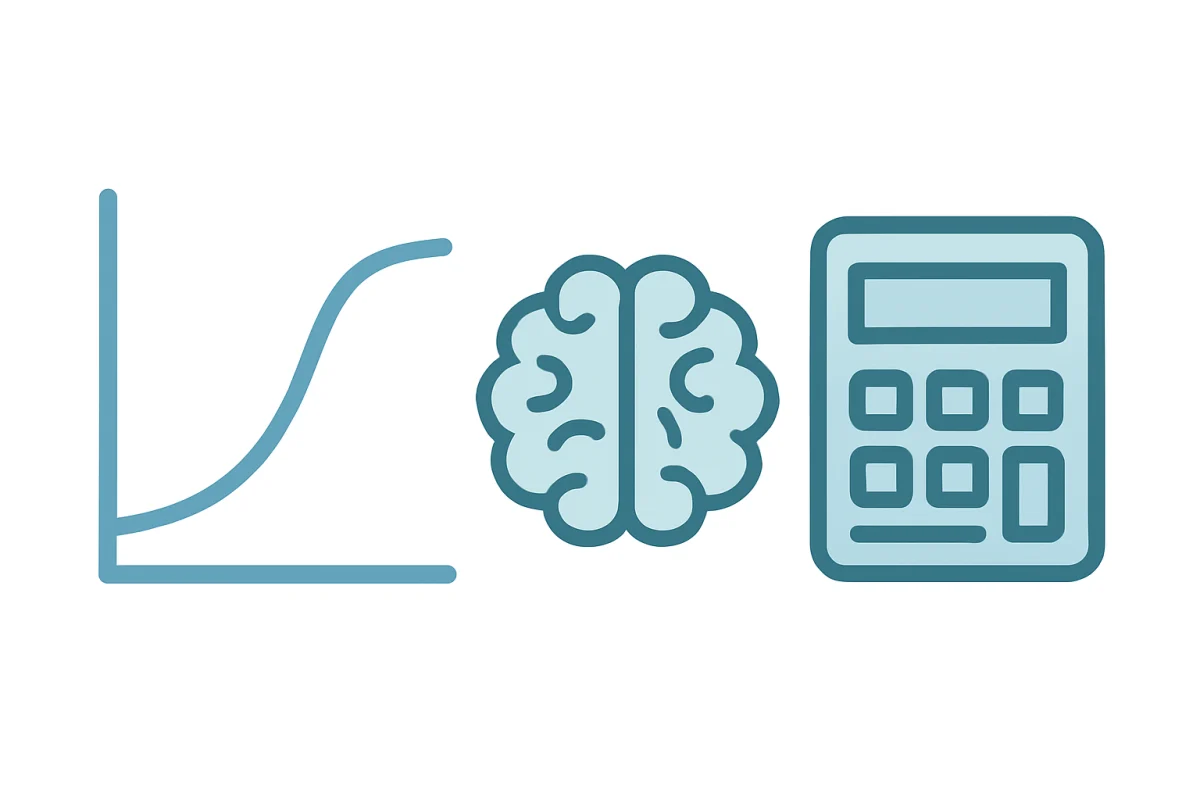
The ratio formula breaks for adults because mental age stops growing while real age keeps going up. Lewis Terman, who built the 1916 Stanford-Binet, observed that measured intelligence improves very little after about age 15 or 16, as quoted by Riot IQ.
That creates a math problem. If an average adult performs like an average 16-year-old, the ratio for a 40-year-old would be 16 ÷ 40 × 100 = 40, which is plainly wrong for a typical person.
The age 16 cap
Early testers handled this by capping the age used in the formula at around 15 or 16 for adults. Most calculators today use 16 as the convention, but it is a workaround, not a finding about how adult minds work.
| Adult example: age 40, IQ 115 | Calculation | Result |
|---|---|---|
| Using real age | 115 × 40 ÷ 100 | 46 years (meaningless) |
| Using the age 16 cap | 115 × 16 ÷ 100 | 18.4 years (rough historical estimate) |
Some online calculators skip this step and apply real age to adults with no warning. That is why a 34-year-old can be told their “mental age” is 21 or a 50-year-old that theirs is 65. Neither number describes anything real. Our article on mental age vs chronological age explains what a gap between the two can and cannot tell you.
Ratio IQ vs Deviation IQ
Modern IQ scores are deviation IQs, not ratio IQs, so feeding one into a mental age calculator mixes two different measures. Deviation IQ compares a person with others of the same age, with an average of 100 and a standard deviation of 15.
| Feature | Ratio IQ | Deviation IQ |
|---|---|---|
| How it is calculated | Mental age ÷ real age × 100 | Position compared with same-age peers |
| Introduced | Stern (1912), Terman’s × 100 (1916) | David Wechsler (1939); Stanford-Binet switched in 1960 |
| Works for adults | No | Yes |
| Used by current clinical tests | No | Yes |
| Produces a mental age | Yes | No |
For children, plugging a modern IQ into the ratio formula still gives a reasonable rough translation into an age level. Just remember it is a translation, not what the test actually reported.
Mental Age Calculator or Mental Age Quiz: Which Do You Need?
A calculator and a quiz answer different questions. A calculator converts an existing IQ score into an age using a formula. A quiz estimates how old your attitudes, habits and reactions seem, based on your answers.
| Your goal | Best tool | What you get |
|---|---|---|
| Check homework or exam answers on MA ÷ CA × 100 | Mental age calculator | An exact ratio answer |
| Understand a child’s IQ report in age terms | Calculator, plus the psychologist who tested them | A rough age-level translation |
| Find out how “old” you think and act as an adult | Mental age test | A fun, self-reflective estimate |
| Assess development, learning or adaptive skills | A licensed psychologist | A standardized, normed evaluation |
Mental age also depends on what is being measured. A child can reason like an older child and still handle emotions like someone their own age, so a single number never covers the whole person.
Common Mistakes When Using a Mental Age Calculator
- Using an adult’s real age. The ratio falls every year without any change in ability. Use the age 16 cap or skip the formula.
- Entering a score from a free online IQ quiz. These quizzes are usually not normed, so the input is unreliable and so is the output.
- Mixing years and months. Convert everything to months first, or everything to decimal years, never both.
- Treating the result as a prediction. A mental age describes test performance at one point in time. It does not lock in a child’s future.
- Trusting claims of “100% accuracy”. A formula is only as good as the score you put into it.
Where the Mental Age Formula Came From
The mental age formula grew out of early 20th century work on children’s school readiness. Each step added a piece of the calculation used today.

- 1905: Alfred Binet and Théodore Simon publish a scale that ranks tasks by age level, giving the idea of mental age.
- 1912: William Stern proposes dividing mental age by chronological age, creating the intelligence quotient.
- 1916: Lewis Terman’s Stanford-Binet multiplies the ratio by 100 to remove decimals.
- 1939 onward: David Wechsler introduces deviation scoring, and the Stanford-Binet adopts it in its 1960 revision.
Binet himself did not see mental age as a fixed or inborn trait, and some disability advocates today regard the term as reductive, according to the Wikipedia entry on mental age. For the full background, read our guide to mental age in psychology.
When a Number Is Not Enough
A mental age calculator is a good tool for learning the formula and translating a child’s score into familiar terms. It is not an assessment, and it cannot diagnose a learning difference or developmental delay.
If you have real concerns about a child’s progress, the right next step is a licensed psychologist using a standardized, normed test. If you are an adult who is simply curious, skip the formula and try our free mental age test, which looks at how you think and act rather than at an IQ score.
Frequently Asked Questions
How do you calculate mental age from IQ?
Multiply the IQ by the person’s real age, then divide by 100. A 10-year-old with an IQ of 120 has a mental age of 12. For young children, do the math in months for a more precise answer.
Does a mental age calculator work for adults?
Not in a meaningful way. Measured reasoning levels off around age 15 or 16 while real age keeps rising, so the ratio gives odd results for adults. Early tests capped the age at about 16, but even that is only a rough historical workaround.
What is the mental age of someone with an IQ of 100?
It equals their real age. An IQ of 100 is average on the ratio scale, so a 9-year-old with an IQ of 100 has a mental age of 9.
Can I use my online IQ test score in a mental age calculator?
You can enter it, but the result will not be reliable. Most free online IQ quizzes are not normed, and modern IQ scores are deviation scores rather than the ratio scores the formula was built for.
Is a mental age calculator the same as a mental age test?
No. A calculator converts an existing IQ score into an age with a formula. A mental age test or quiz estimates how old your thinking and habits seem based on your answers, with no IQ score needed.
Is mental age still used by psychologists?
Not for IQ scoring. Current clinical tests such as the Stanford-Binet and Wechsler scales use deviation IQ. Age-equivalent scores still appear in some child development assessments, and clinicians use them carefully.