How to Remember Everything You Read: A 7-Step System That Works
You will not remember every sentence you read, and you do not need to. What you can keep is the argument, a handful of key ideas, and what you decided to do about them. This guide explains how to remember everything you read that is worth remembering, using methods that hold up in memory research.
The whole system adds about five minutes per chapter. Most of the gain comes from one change: stop rereading, and start recalling.
Quick Answer
To remember what you read, test yourself on it instead of rereading it. After each chapter or article, close it and write or say the main points from memory. Check what you missed. Then repeat that short recall the next day, about a week later, and about a month later. Add a clear reason for reading and a one-page summary in your own words, and you will keep far more than highlighting or rereading can give you.
- Before: decide what you want from the text and skim its structure.
- During: read with questions and mark only a few passages.
- After: recall from memory, then explain it in plain words.
- Later: review at growing gaps (1 day, 1 week, 1 month).
- Always: keep one page of notes and act on one idea.
Can You Really Remember Everything You Read?
No. Human memory does not store text like a hard drive. It keeps meaning, and it drops most detail that never gets used again. That is normal, and it is efficient.
A better target is this: for every book or article that matters to you, be able to recall the main argument, three to five key ideas, and one thing you will do differently. That is a goal you can reach, and it is what most people mean when they say they want to remember everything.
So the real problem is not a weak memory. It is a reading method that never asks your memory to do any work.
Why You Forget What You Read
The forgetting curve, and what it really measured
In the 1880s, the German psychologist Hermann Ebbinghaus memorized lists and tracked how quickly they faded. His forgetting curve shows the steepest loss in the first hours, followed by a slower decline. A 2015 replication at the University of Amsterdam produced a very similar curve.
Two details are often left out. First, Ebbinghaus used nonsense syllables, which were chosen because they carry no meaning. Second, he measured how much faster he could relearn a list, not what percentage he could recite. Popular claims such as “you forget 80% within a day” stretch those results well beyond what they show.
Ideas that mean something to you, and that connect to what you already know, generally hold up better than meaningless syllables. The useful lesson is about timing: forgetting is fastest soon after reading, so your first review should come soon too.
Recognizing is not remembering
When you reread a page or look over your highlights, the text feels familiar. That feeling is recognition. Recall is different: it means producing the idea with the page closed.
A widely cited 2006 study by Roediger and Karpicke shows why this matters. Students read prose passages, then either restudied them or took recall tests with no feedback. Tested five minutes later, the restudy group did better. Tested two days or one week later, the group that had practiced recall remembered substantially more.
The restudy group was also more confident. In other words, the method that feels most effective in the moment is the one that fails you later. That is why so many readers trust rereading and highlighting.
What Works and What Only Feels Like It Works
In 2013, a team led by John Dunlosky reviewed ten common learning techniques and rated how useful each one is. Here are the eight most relevant to reading.
| Technique | Rating in the review | What it looks like when you read |
|---|---|---|
| Practice testing (active recall) | High | Close the book and write what you remember |
| Distributed practice (spaced review) | High | Short reviews spread over days and weeks |
| Elaborative interrogation | Moderate | Asking “why is this true?” as you read |
| Self-explanation | Moderate | Explaining how a new idea fits what you know |
| Interleaved practice | Moderate | Mixing topics, more useful for practice problems than for reading |
| Summarization | Low | Writing a summary while looking at the text |
| Highlighting and underlining | Low | Marking passages as you go |
| Rereading | Low | Reading the chapter a second time |
Low does not mean useless. Highlighting helps you find a passage again, and a summary written from memory is really a form of recall. The point is that marking and rereading do not build memory by themselves. The system below is built on the two high-rated techniques, with the moderate ones in support.
The 7-Step System to Remember What You Read
Step 1: Decide why you are reading
Before you start, write one line: “I am reading this to learn X so that I can Y.” A clear purpose tells your brain what to keep and what to let go.
One strong version of this is to read as if you will have to teach it. In a study published in Memory and Cognition, people who expected to teach a passage recalled more of it, and organized it better, than people who expected a test. Nobody actually taught anything. The expectation alone changed how they read.
Step 2: Preview before you read
Spend two minutes on the table of contents, the headings, and the summary or conclusion. Mortimer Adler described this kind of quick survey in his classic guide How to Read a Book.
Previewing gives you a frame, and details are easier to remember when they have somewhere to go. It also tells you early whether the book deserves your time. Quitting a weak book is a retention strategy too.
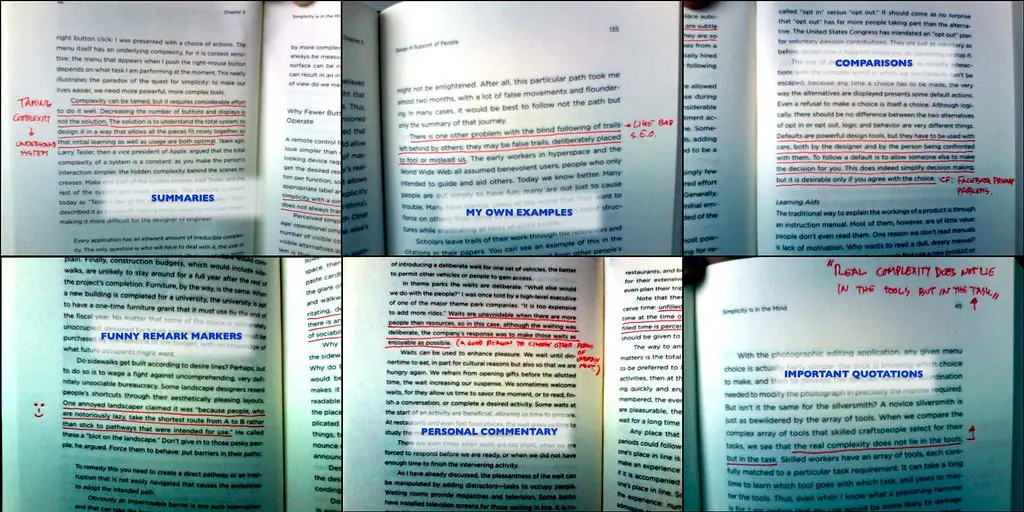
Step 3: Read with questions and mark sparingly
Turn each heading into a question and read to answer it. In the margin, write short notes in your own words: a question, a link to something you already know, or a point you disagree with.
Keep highlights to a few per chapter. If everything is marked, nothing stands out. When you notice your eyes moved but nothing went in, stop, look away, and say what the last paragraph claimed. If you cannot, read it again with that question in mind.
Step 4: Close the book and recall
This is the step that does most of the work. At the end of each chapter, close the book, take a blank page, and write everything you remember: the main claim, the supporting points, and any examples.
Give it two or three minutes, even when it feels slow. Then open the book and add what you missed in a different color. The gaps show you exactly what needs another look.
The effort is the point. Pulling an idea out of memory strengthens it in a way that seeing it again does not. Do not check the page after a few seconds of thinking. Stay with the blank for a moment first.
Step 5: Explain it in plain words
Now explain the chapter as if to someone who has never met the topic. Use short sentences and no jargon. This approach is often called the Feynman Technique, after the physicist Richard Feynman.
Wherever you stall or reach for the author’s exact wording, you have found a gap in your understanding. Go back to that part only. You can do this out loud, in a voice note, in a message to a friend, or in three written sentences.
Step 6: Review on a spaced schedule
One recall session is not enough. Memory lasts when you return to an idea several times with gaps in between. The question is how long the gaps should be.
A study of more than 1,350 people found that the best gap depends on how long you want to remember. For a test one week away, the ideal gap was about 20 to 40% of that week. For a test one year away, it was about 5 to 10% of the year.
| How long you want to remember | Good gap before your first review | Basis |
|---|---|---|
| About 1 week | 1 to 3 days | Measured in the study |
| About 1 month | About 1 week | Estimate between the two measured points |
| About 1 year | About 3 to 5 weeks | Measured in the study |
From a practical standpoint, a simple default covers most reading: recall again after 1 day, 1 week, and 1 month. Each review is two minutes of recall from memory, followed by a quick check of your notes. It is not a reread.
If you miss a date, review late. A late review is still worth far more than none. For facts you must know exactly, such as terms, dates, or formulas, a flashcard app like Anki will handle the scheduling for you. For ideas and arguments, a blank page is enough.
Step 7: Keep one page and use one idea
When you finish, write a single page from memory first, then correct it against the book. Include:
- The main argument in one or two sentences
- Three to five ideas worth keeping, in your own words
- One claim you doubt or disagree with
- One thing you will do differently
- One link to something else you have read
Keep every page in one searchable place, whether that is a notebook or a notes app. Then act on the one thing within a week. Using an idea ties it to an experience, and experiences are much harder to forget than sentences.
The 5-Minute Chapter Routine
Here is the system as a routine you can start today.
- Before (30 seconds): reread your one-line purpose and skim the chapter headings.
- Read: read the chapter at your normal pace with a pencil in hand.
- Recall (2 to 3 minutes): close the book and write what you remember.
- Check (1 minute): open the book and add what you missed in another color.
- Explain (1 minute): say the chapter’s point in three plain sentences.
- Next day (2 minutes): before you read on, recall yesterday’s chapter from memory.
For example, suppose you read a chapter arguing that small daily habits add up over time. Your recall page might hold the main claim, one example the author used, and a question about whether the idea applies to breaking habits as well. The next morning, you try to rebuild that page from memory before starting the next chapter. That is the whole method.
How to Adapt the System to What You Read
Not all reading deserves the full routine. Match the effort to the goal.
| What you are reading | Goal | What to do | What to skip |
|---|---|---|---|
| Non-fiction book | Keep the argument and a few usable ideas | All seven steps and a one-page note | Copying long quotes |
| Textbook or course reading | Recall facts and explain concepts in an exam | Recall after every section, flashcards for terms, answer practice questions before rereading | Rereading and heavy highlighting as your main method |
| Online article or report | Find and reuse one or two points later | Save the link with two lines: the claim and why it matters to you | Saving with no note attached |
| Fiction | Remember the story, the characters, and how it felt | Write one paragraph when you finish and talk about it with someone | Flashcards and schedules, unless you are studying the book |
Smaller Things That Help
These will not replace recall and spacing, but they make both easier.
- Sleep between sessions. In a 2016 study in Psychological Science, people who slept between two learning sessions relearned faster and retained more later than people who did both sessions on the same day. The material was vocabulary, not books, but the habit transfers well: recall in the evening, then review briefly the next morning. Sleep is also one of several everyday habits that increase memory power more broadly.
- Paper for hard material. A meta-analysis of 54 studies with more than 170,000 participants found a small comprehension advantage for paper over screens. The advantage held for informational texts and grew under time pressure. It did not appear for narrative texts alone.
- Protect your attention. You cannot remember what you never took in. Put your phone in another room and read in focused blocks of 25 to 30 minutes.
- Say key lines out loud. Speaking the few points you most want to keep makes them more distinctive than lines read silently.
Common Mistakes That Waste Reading Time
- Treating highlighting as the method. A highlight marks a passage. It does not store it.
- Rereading instead of recalling. It feels productive and fades fast.
- Checking the page too soon. If you look after two seconds, you are rereading again.
- Capturing everything. Fifty highlights per chapter become a pile you never open. Five ideas you revisit are worth more.
- Reviewing once. A single review on the same day adds little. Space it out.
- Reading without a purpose. With no question in mind, nothing stands out as worth keeping.
- Building a system too complex to keep. A routine you follow beats a perfect one you drop in week two.
How to Tell If It Is Working
One week after you finish a book or a long article, try this 60-second test without looking at your notes:
- State the main argument in one sentence.
- Name three ideas from it.
- Name one thing you did or changed because of it.
If you can do all three, the system is working. If you get stuck on the first two, add more recall and tighten your review dates. If you get stuck on the third, choose reading you can apply sooner, or commit to one action before you close the book.
The Bottom Line
You cannot remember everything you read, but you can stop losing the parts that matter. Read with a purpose, close the book and recall, explain it simply, and return to it after a day, a week, and a month. Keep one page per book and act on one idea.
Start with your next chapter. Five minutes of recall will tell you more about what you learned than another hour of reading.
If you are curious about how your thinking style compares with your actual age, try our free mental age test, or read our guide on how mental age is calculated.
Sources
- Roediger, H. L., and Karpicke, J. D. (2006). Test-enhanced learning: taking memory tests improves long-term retention. Psychological Science.
- Dunlosky, J., et al. (2013). Improving students’ learning with effective learning techniques. Psychological Science in the Public Interest.
- Murre, J. M. J., and Dros, J. (2015). Replication and analysis of Ebbinghaus’ forgetting curve. PLOS ONE.
- Cepeda, N. J., et al. (2008). Spacing effects in learning: a temporal ridgeline of optimal retention. Psychological Science.
- Nestojko, J. F., et al. (2014). Expecting to teach enhances learning and organization of knowledge in free recall of text passages. Memory and Cognition.
- Delgado, P., et al. (2018). Don’t throw away your printed books: a meta-analysis on the effects of reading media on reading comprehension. Educational Research Review.
- Mazza, S., et al. (2016). Relearn faster and retain longer: along with practice, sleep makes perfect. Psychological Science.
Frequently Asked Questions
Is it possible to remember everything you read?
No. Human memory keeps meaning rather than exact text, and it drops most detail that is never used again. A realistic goal is to remember the main argument, three to five key ideas, and one action from each book. Recalling from memory and reviewing at spaced intervals makes that goal achievable for most readers.
Why do I forget what I read so quickly?
Forgetting is fastest in the first hours and days after you read, and reading by itself is passive. If you never pull the ideas back out of memory, your brain has little reason to keep them. A two-minute recall right after reading, repeated the next day, slows that loss far more than reading the passage again.
Does highlighting help you remember what you read?
Not much by itself. A major review of study techniques rated highlighting and underlining as low utility for learning. Highlighting is useful for marking passages you want to find later. Memory comes from what you do next: closing the book and recalling the idea in your own words.
Is rereading a good way to remember a book?
Rereading works in the very short term and poorly in the long term. In one well-known experiment, students who reread a passage did better after five minutes, but students who tested themselves remembered substantially more after two days and after one week. Reread great books for new insight, but use recall to make them stick.
How many times should I review something to remember it?
Plan on at least three short recall sessions after your first read: the next day, about a week later, and about a month later. Each one can take two minutes. For material you need for years, such as professional knowledge or exam content, keep adding reviews at longer and longer gaps.
Is it better to read on paper or on a screen?
For informational reading, paper has a small advantage. A meta-analysis of 54 studies found better comprehension on paper for informational texts, especially under time pressure, and no clear difference for narrative texts alone. If you are studying something difficult, print it or use a paper copy when you can. For novels, use whichever you prefer.
How can I remember what I read without taking notes?
Use recall that needs no paper. When you finish a chapter, look away and say the main points out loud. Tell someone about the book the same day. Before your next reading session, spend one minute recalling the previous one. These spoken recalls use the same memory mechanism as written ones.