Mental Age in Psychology: Definition, Formula and Why It Changed
You may have met the term mental age in a psychology class, in a news story, or on an online quiz. It sounds simple, but it has a precise meaning in the history of intelligence testing, and that meaning is not the one most quizzes use.
This guide gives the mental age psychology definition in plain words, shows where the idea came from, and explains why psychologists replaced it.
Quick Answer
Mental age is a score from early intelligence tests that names the age group whose average test performance a person matches. A child of 8 who answers test questions as well as a typical 10-year-old has a mental age of 10.
The French psychologist Alfred Binet introduced the idea in the early 1900s. Modern intelligence tests no longer use mental age. They compare each person with other people of the same age instead.
An online mental age test is a different thing. It is a quiz for fun and self-reflection, not a psychological measurement.
What Is Mental Age in Psychology?
In psychology, mental age is the chronological age at which a given level of test performance is average. Britannica describes it as an intelligence test score expressed as the chronological age for which that level of performance is typical.
Mental age describes how someone did on one test at one point in time. It does not describe maturity, personality or worth. Binet’s tests sampled skills such as attention, comprehension, reasoning and memory, so a mental age only ever summarized performance on those tasks.
A Simple Example
Picture three 8-year-olds who take the same test.
- The first scores like a typical 10-year-old. Mental age: 10.
- The second scores like a typical 8-year-old. Mental age: 8.
- The third scores like a typical 6-year-old. Mental age: 6.
All three have the same chronological age. Only their mental age differs, because mental age follows test performance, not birthdays.
Other Names for Mental Age
Textbooks also call mental age an age-equivalent score, an age norm or a test age, as the Encyclopedia of School Psychology notes. All of these names mean the same thing.
Binet himself wrote about a child’s “mental level”. According to the historian Henry Minton, writing for York University’s Classics in the History of Psychology, the phrase “mental age” came from American translators and implied a fixed ladder of development that Binet did not intend.
Mental Age vs Chronological Age vs IQ
Mental age is a test result, chronological age is the time since birth, and IQ is a score built on a comparison. The table shows how the three differ.
| Mental age | Chronological age | IQ | |
|---|---|---|---|
| What it is | The age group whose average test performance a person matches | A person’s actual age since birth | A score showing how test performance compares with a reference group |
| How you get it | From an age-graded intelligence test | From the date of birth | Old method: mental age ÷ chronological age × 100. Modern method: comparison with people of the same age |
| Unit | Years | Years and months | Points, with 100 as the average |
| Who it suits | Children only | Everyone | Children and adults in the modern system |
| Used in testing today? | No, except as a rough way to explain a result | Yes | Yes, as a deviation score |
Where Did the Idea of Mental Age Come From?
Mental age came from a practical school problem in Paris. Binet needed a fair way to find children who were falling behind and needed extra teaching.
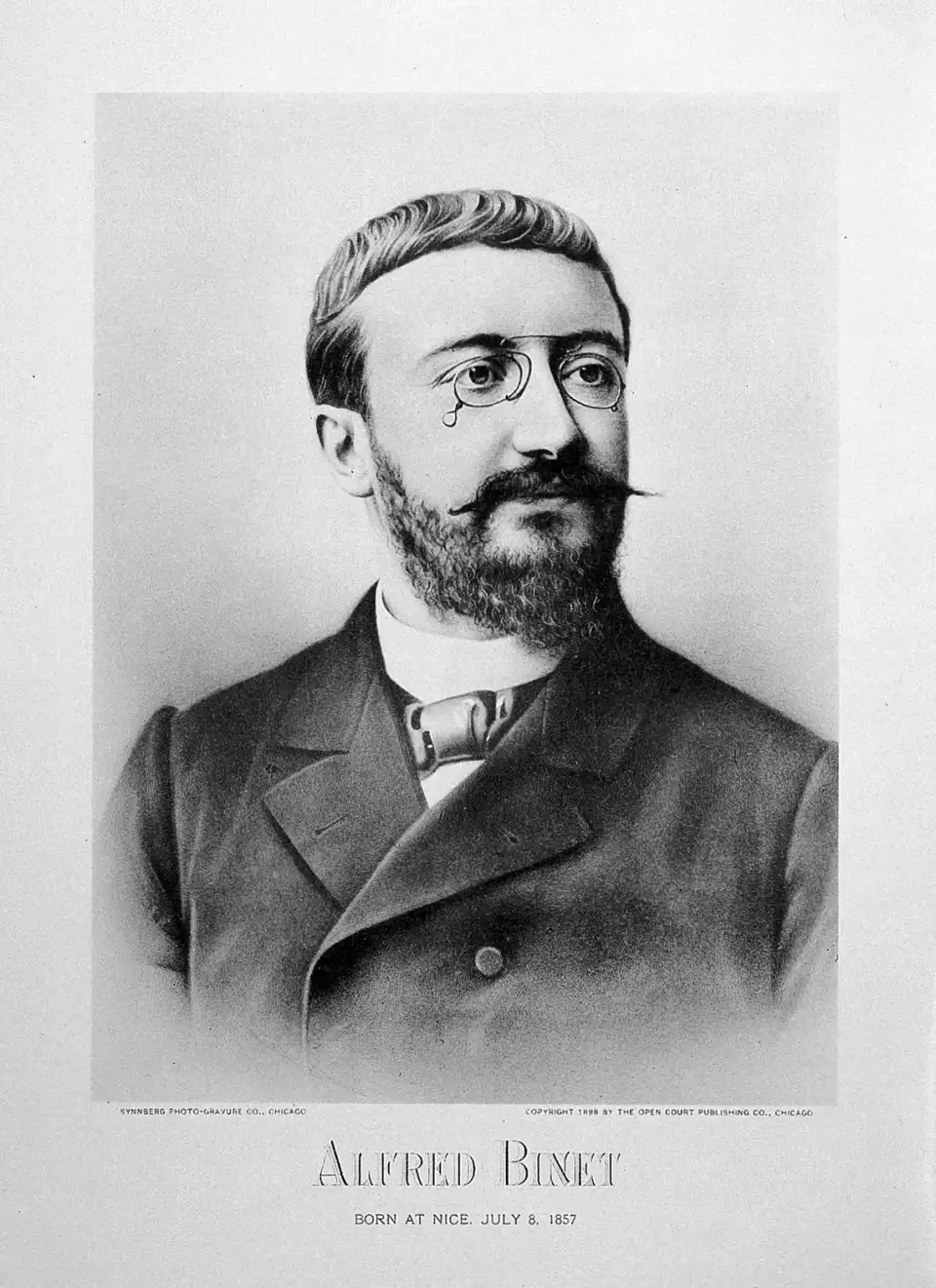
Binet and Simon, 1905 to 1908
In 1904 the French minister of public instruction appointed Binet to a commission on Paris schoolchildren who were struggling. In 1905 Binet and the physician Théodore Simon published their first scale: thirty tests arranged from easiest to hardest.
In 1908 they revised the scale and grouped the tests by age level. From then on, a 6-year-old who performed like an average 8-year-old could be given a mental level of 8.
This explains why some sources date mental age to 1905 and others to 1908. The test dates from 1905, and the age levels date from 1908. Binet meant the result as a snapshot of a child’s present level, used to decide on school placement, not as a lifelong label.
Stern, Terman and the IQ Formula
Two other psychologists turned mental age into the IQ score.
- 1912: The German psychologist William Stern divided mental age by chronological age to produce a quotient.
- 1916: Lewis Terman at Stanford University published the Stanford-Binet test and multiplied that quotient by 100, which removed the decimals and created the IQ score.
The Stanford-Binet used this ratio method in its 1916 and 1937 editions, according to the Encyclopedia of Educational Psychology.
The Original Mental Age Formula
The original formula was IQ = (mental age ÷ chronological age) × 100. A child whose mental age equals their chronological age scores exactly 100.
Take an 8-year-old with a mental age of 10: 10 ÷ 8 × 100 = 125. An 8-year-old with a mental age of 6 scores 75. For more worked examples, see our guide on how to calculate mental age.
Why Psychologists Moved Away From Mental Age
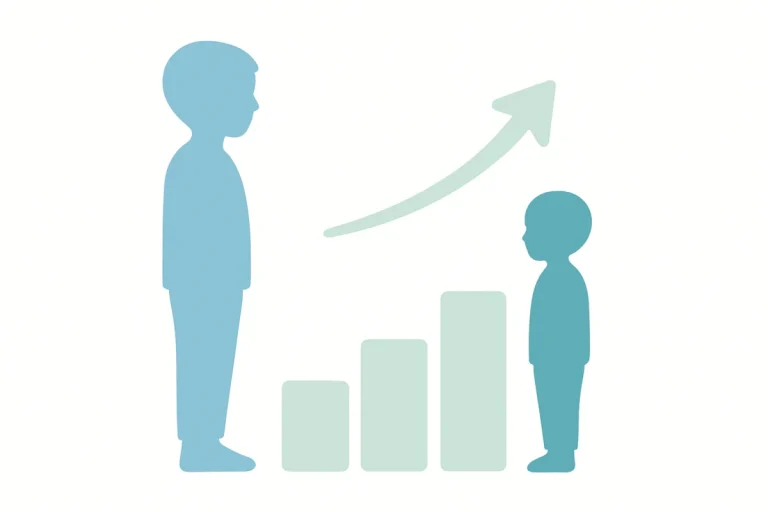
Psychologists dropped mental age because it only works for children. Test scores rise through childhood and level off in the mid to late teens, while chronological age keeps climbing.
Three Problems With Mental Age
- It breaks for adults. If average performance stops rising at about 16, a typical 40-year-old has a mental age of 16 and a ratio IQ of 40, which is plainly wrong. Sources differ on the exact plateau: Terman wrote of 15 or 16, while Britannica notes that adults taking a test were assigned a chronological age of 18.
- The units are not equal. A child develops far more between ages 2 and 3 than between ages 11 and 12. One year of mental age does not mean the same thing at every age.
- One number hides the detail. Two children with the same mental age may have passed different questions. A single figure cannot show that someone is strong on verbal tasks and weaker on nonverbal ones.
The psychologist L. L. Thurstone made this case in a 1926 paper in Psychological Review. He argued that the mental age concept becomes ambiguous once it is applied to adults, and he proposed ranking each person against others of the same age instead.
What Replaced Mental Age
Deviation IQ replaced mental age. David Wechsler’s 1939 test scored people against others in their own age group, and later intelligence tests adopted the same approach.
In this system the average score is set at 100 and the standard deviation at 15, so a score between 85 and 115 falls in the normal range. No mental age is calculated at all. The letters IQ survived, but the quotient did not.

Mental Age in AP Psychology: What to Remember
For AP Psychology or an introductory course, you need a short, exact definition plus the story of how scoring changed. These five points cover the core of the topic.
- Mental age: the age level at which a person’s test performance matches the average for that age.
- Chronological age: a person’s actual age since birth.
- Origin: Alfred Binet, working with Théodore Simon in France, to identify schoolchildren who needed extra help.
- Old formula: Stern’s ratio of mental age to chronological age, multiplied by 100 by Terman for the Stanford-Binet.
- Today: deviation IQ, which compares a person with same-age peers and does not use mental age.
One detail is worth stating in any answer: mental age is an inference from a test, not a biological age. Check your own course materials for the unit this topic belongs to, because study sites number it differently.
If you are revising a whole unit, our guide on how to remember everything you read can help the terms stick.
What Does Mental Age Mean on an Online Quiz?
On an online quiz, mental age means something looser: how young or old your answers seem compared with popular ideas about different ages. A quiz borrows Binet’s phrase but not his method.
| Mental age in psychology history | Mental age on an online quiz | |
|---|---|---|
| Based on | Performance on standardized test tasks, compared with age norms | Answers about preferences, habits and outlook |
| Designed for | Schoolchildren | Anyone, mostly adults |
| What it tells you | A level of test performance at the time of testing | A playful reading of your outlook |
| Can it diagnose anything? | No | No |
That includes ours. Our mental age test is built for fun and self-reflection. It does not measure intelligence, it is not a clinical tool, and its result is a conversation starter, not a fact about your mind.
Why the Term Mental Age Needs Care
Mental age is not a medical diagnosis, and it does not sum up a person. You will still see phrases like “the mental age of a child” in news reports about adults with intellectual disabilities.
Some disability advocates and researchers describe that usage as reductive or infantilizing, because an adult with decades of life experience is not a child. A 2024 paper in the Journal of Policy and Practice in Intellectual Disabilities examined how psychologists view the term when it is applied to adults with an intellectual disability.
If you have concerns about your own or a family member’s development, learning or mental health, speak with a qualified psychologist or doctor. No article or quiz can replace a professional assessment.
Key Takeaway
Mental age is a historical test score: the age group whose average performance a person matched on an early intelligence test. It gave psychology its first IQ formula, then gave way to deviation IQ because it could not handle adults.
Use the term for what it is, a piece of testing history and a bit of fun on a quiz, and not as a verdict on anyone.
Frequently Asked Questions
What is the simple definition of mental age?
Mental age is the age group whose average performance on an intelligence test a person matches. A 7-year-old who scores like a typical 9-year-old has a mental age of 9.
Who came up with the concept of mental age?
The French psychologist Alfred Binet, working with Théodore Simon. Their first intelligence scale appeared in 1905, and the 1908 revision grouped the tests by age level. Binet’s own term was mental level.
Is mental age the same as IQ?
No. Mental age is a level of test performance expressed in years. The old ratio IQ divided mental age by chronological age and multiplied by 100. Modern IQ compares a person with others of the same age and does not use mental age.
Do psychologists still use mental age?
Rarely. Modern intelligence tests report deviation scores with an average of 100. Age-equivalent scores sometimes appear as a rough way to explain a result, because the idea is easy for the public to understand.
Can an adult have a mental age?
The concept was built for children. Test performance levels off in the mid to late teens, so a mental age stops being meaningful for adults. This is the main reason tests switched to comparing people with their own age group.
Is an online mental age test accurate?
An online mental age quiz does not measure intelligence and cannot diagnose anything. It is a tool for fun and self-reflection. For concerns about development, learning or mental health, see a qualified professional.