IQ of 70: What Is the Mental Age? (Child and Adult Math)
If you have seen an IQ score of 70 and wondered what age it matches, the short answer is this: under the old ratio formula, an IQ of 70 means a mental age equal to 70% of a person’s real age. A 10-year-old with an IQ of 70 would have a mental age of about 7. For adults, the historical math gives a mental age of roughly 11 to 12.5 years, but that number needs careful reading.
This guide shows the exact math for children and adults, gives tables for IQ 70, 72, 73, 75 and 80, and explains what a score of 70 really means on modern tests.
Quick Answer
An IQ of 70 corresponds to a mental age of 70% of chronological age. The formula is mental age = IQ x chronological age / 100.
- Child aged 10: 70 x 10 / 100 = a mental age of 7.
- Adult (age capped at 16): 70 x 16 / 100 = a mental age of about 11.
- Adult (age capped at 18): 70 x 18 / 100 = a mental age of about 12.5.
Modern IQ tests no longer use mental age at all. They compare you with people your own age, and on that scale an IQ of 70 sits at about the 2nd percentile. If you are curious about how mature your thinking feels rather than your IQ, you can try our free mental age test.

How an IQ Score Turns Into a Mental Age
Mental age is the age level at which a person performs on thinking tasks. A child who solves the problems a typical 8-year-old can solve has a mental age of 8, whatever their birthday says.
The idea comes from French psychologist Alfred Binet, who built the first age-graded scale with Théophile Simon in 1905 to find Paris schoolchildren who needed extra help. In 1912, German psychologist William Stern divided mental age by chronological age to make a “mental quotient.” In 1916, Lewis Terman at Stanford multiplied that quotient by 100 and called it the intelligence quotient, or IQ (Encyclopedia.com).
So the original ratio IQ formula is:
IQ = (mental age / chronological age) x 100
Turn it around and you get the formula people use when they ask “what is the mental age for an IQ of 70”: mental age = IQ x chronological age / 100. For a deeper walk-through with more examples, see our guide on how to calculate mental age.
The 4-Step Method for Any IQ Score
- Write down the IQ score (for example, 70).
- Write down the person’s age in years. For anyone older than 16 to 18, use the capped age instead of their real age (more on this below).
- Multiply the IQ by the age.
- Divide the result by 100. That number is the estimated mental age.
Worked Example: A 10-Year-Old With an IQ of 70
Take a 10-year-old who scores 70. Multiply 70 by 10 to get 700, then divide by 100. The mental age is 7, which means the child performed on the test like a typical 7-year-old.
The same logic works in reverse. A 10-year-old with a mental age of 7 has a ratio IQ of 7 / 10 x 100 = 70. This exact example appears in psychology explainers such as ScienceInsights.
IQ 70 Mental Age by Age
The mental age for an IQ of 70 changes with the person’s age, because it is always 70% of that age. This table applies the ratio formula at common ages.
| Chronological age | Calculation | Mental age at IQ 70 |
|---|---|---|
| 6 years | 70 x 6 / 100 | 4.2 years |
| 8 years | 70 x 8 / 100 | 5.6 years |
| 10 years | 70 x 10 / 100 | 7 years |
| 12 years | 70 x 12 / 100 | 8.4 years |
| 14 years | 70 x 14 / 100 | 9.8 years |
| 16 years | 70 x 16 / 100 | 11.2 years |
| Adult (cap of 16) | 70 x 16 / 100 | About 11 years |
| Adult (cap of 18) | 70 x 18 / 100 | About 12.5 years |
What About an Adult With an IQ of 70?
For an adult, the ratio formula gives a mental age of about 11 to 12.5 years, because the age in the formula is capped at 16 to 18. You do not multiply by the adult’s real age.
The cap exists because average test performance stops rising in the mid to late teens. Terman noted that measured intelligence “improves but little after the age of 15 or 16 years,” as quoted by Riot IQ. Early Stanford-Binet scoring dealt with this by capping the age used in the formula, which matches that plateau of about 15 to 16. Britannica describes adults being assigned a chronological age of 18 in the calculation. That is why this guide shows both results.
A common mistake online is to multiply an adult’s real age by the IQ. Using that method, a 30-year-old with an IQ of 75 would get a “mental age” of 22, which makes no sense: a typical 22-year-old performs at about the same level as a typical 30-year-old. The cap prevents this error.
Mental Age for IQ 72, 73, 75 and 80
Scores close to 70 follow the same rule. The table below shows the estimated mental age for a 10-year-old and for an adult under both caps, plus the approximate percentile on a modern test (mean 100, standard deviation 15, calculated from the normal curve).
| IQ score | Mental age at age 10 | Adult (cap 16) | Adult (cap 18) | Approx. percentile |
|---|---|---|---|---|
| 70 | 7.0 | 11.2 | 12.6 | 2nd |
| 72 | 7.2 | 11.5 | 13.0 | 3rd |
| 73 | 7.3 | 11.7 | 13.1 | 4th |
| 75 | 7.5 | 12.0 | 13.5 | 5th |
| 80 | 8.0 | 12.8 | 14.4 | 9th |
Notice how small the gaps are. The difference between an IQ of 70 and an IQ of 75 is only half a year of mental age for a 10-year-old, which is smaller than the normal error of a single test.
Why Mental Age Is Only a Historical Estimate
Mental age is a historical measure that modern IQ tests no longer report. The ratio formula worked reasonably well for children, but it broke down for adults and produced uneven score spreads across age groups.
Here is the core problem. An average 40-year-old performs at roughly the same level as an average 16-year-old, so the ratio formula would give that adult an IQ of 40, which is plainly wrong. Capping the age fixed the math but not the deeper issue: adult abilities do not grow in a straight line, so “years of mental age” stop meaning much after the teens.
In 1939, David Wechsler introduced the deviation IQ. Instead of comparing you with children of different ages, it compares you with people your own age, with an average of 100 and a standard deviation of 15. Today’s Wechsler scales and the current Stanford-Binet both use this method. Our article on mental age in psychology covers this shift in more detail.
To see what the original style of age-graded testing looks like for young children, this short video from the Testing Mom channel walks through typical Stanford-Binet question types, such as picture absurdities and visual pattern puzzles.
What an IQ of 70 Means on Today’s Tests
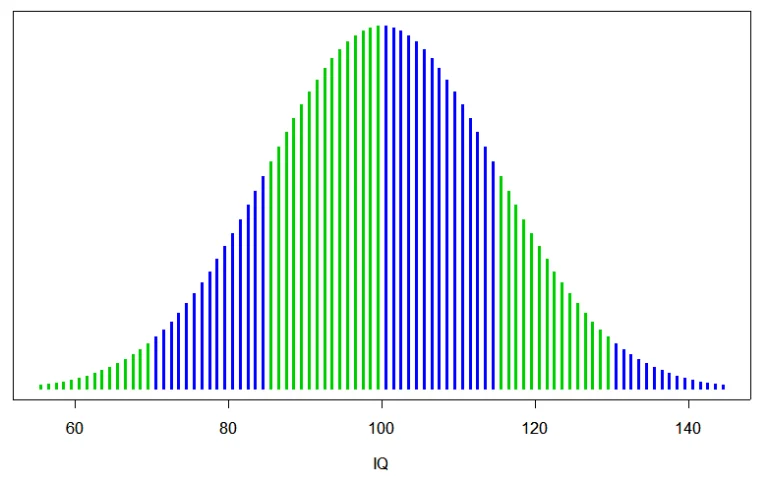
On a modern test, an IQ of 70 means a score two standard deviations below the average of 100. That single fact explains most of what the number does and does not tell you.
Percentile: About the 2nd
An IQ of 70 sits at about the 2nd percentile, so roughly 98 out of 100 people score higher. Riot IQ puts it at the 2.3rd percentile, or about 1 in 44 people scoring at or below 70. On the WAIS-IV, 70 falls on the line between the “Extremely Low” range (below 70) and the “Borderline” range (70 to 79).
The Score Is a Range, Not a Point
Every IQ test has measurement error of about 5 points. In Hall v. Florida (2014), the U.S. Supreme Court described an IQ score as best understood as a range of about five points on either side. So a recorded 70 really means a true score somewhere between about 65 and 75.
That range carries over to mental age. For a 10-year-old, it means a mental age between about 6.5 and 7.5. For an adult using a cap of 16, it means about 10.4 to 12 years. Any single mental age figure is therefore less precise than it looks.
A Score of 70 Is Not a Diagnosis
An IQ of 70 does not, by itself, mean a person has an intellectual disability. The DSM-5 no longer relies on a fixed IQ cutoff. A diagnosis also requires real difficulties with everyday adaptive skills, such as managing money, time, communication and self-care, that began during the developmental period (The Transmitter).
Two people with the same score of 70 can live very different lives. Support, health, education and opportunity shape daily functioning at least as much as the test number does.
Why “The Mind of a Child” Is the Wrong Picture
An adult with a mental age estimate of 11 does not think like an 11-year-old. The number only says that their score on certain test tasks matches the average score of that age group.
Adults bring decades of life experience, work skills, relationships, preferences and emotional maturity that no child has. Describing an adult by a child’s age can lead to people being talked down to or given fewer choices, a concern that psychologists and disability advocates raise, as summarized by ScienceInsights. A more accurate approach is to describe specific strengths and the specific support a person needs. Our guide on mental age vs chronological age explains what a gap between the two really means.
What to Do After a Score Near 70
If you or someone you care about received a score near 70, these steps help you understand it properly:
- Check where the score came from. A full assessment by a licensed psychologist (such as a WAIS or Stanford-Binet) is very different from a free online quiz.
- Ask for the full report. Look at the subtest scores, not only the total. Many people have clear strengths that the single number hides.
- Remember the range. Treat 70 as roughly 65 to 75. Illness, stress, fatigue or low motivation on test day can lower a score.
- Ask about adaptive skills. If a diagnosis is being discussed, a proper evaluation should include everyday living skills, not just IQ.
- Focus on support, not labels. Concrete, hands-on learning, clear routines and practical training help people near this range do well at school and work.
Mental Age Quiz vs IQ Test: What Is the Difference?
A clinical IQ test measures reasoning, memory, processing speed and verbal skills under controlled conditions, and is scored against a large age-matched sample. An online mental age quiz is a light self-reflection tool that looks at attitudes, habits and how “young” or “mature” your outlook feels.
| Feature | Clinical IQ test | Online mental age quiz |
|---|---|---|
| Given by | Licensed psychologist | Yourself, online |
| What it measures | Cognitive abilities | Outlook, habits and preferences |
| Scoring | Deviation IQ, mean 100, SD 15 | An age-style result for fun |
| Used for diagnosis | Yes, with adaptive assessment | No |
| Time | Often an hour or more | A few minutes |
Our mental age test belongs in the second column. It is a quick, fun way to reflect on your mindset, not a measure of IQ.
The Bottom Line
Under the old ratio formula, an IQ of 70 equals a mental age of 70% of chronological age: about 7 for a 10-year-old and about 11 to 12.5 for an adult. On modern tests, 70 means roughly the 2nd percentile, with a true range of about 65 to 75. It is a starting point for understanding someone’s abilities, not a label for who they are.
Frequently Asked Questions
What is the mental age of an adult with an IQ of 70?
Using the historical ratio formula with the adult age capped at 16 to 18, an IQ of 70 gives a mental age of about 11 to 12.5 years. Modern tests no longer report mental age, and the figure does not mean the adult thinks like a child.
What is the mental age of a 10-year-old with an IQ of 70?
About 7 years. Multiply 70 by 10 and divide by 100. The child performed on the test like a typical 7-year-old.
Is an IQ of 70 an intellectual disability?
Not by itself. The DSM-5 does not use a fixed IQ cutoff. A diagnosis also needs significant difficulties with everyday adaptive skills that began during development, confirmed by a qualified professional.
What percentile is an IQ of 70?
About the 2nd percentile. Roughly 98 out of 100 people score higher, because 70 is two standard deviations below the average of 100.
What is the mental age for an IQ of 75 or 80?
For a 10-year-old, IQ 75 gives a mental age of 7.5 and IQ 80 gives 8. For an adult with the age capped at 16, IQ 75 gives about 12 and IQ 80 about 12.8.
Can an IQ score of 70 change?
A retest can differ because every IQ test has about 5 points of measurement error, and health, stress or motivation on test day can affect results. A recorded 70 is best read as a range of about 65 to 75.